MBBS Course Details
- Sep 30, 2025
- 4 min read
Updated: Oct 8, 2025
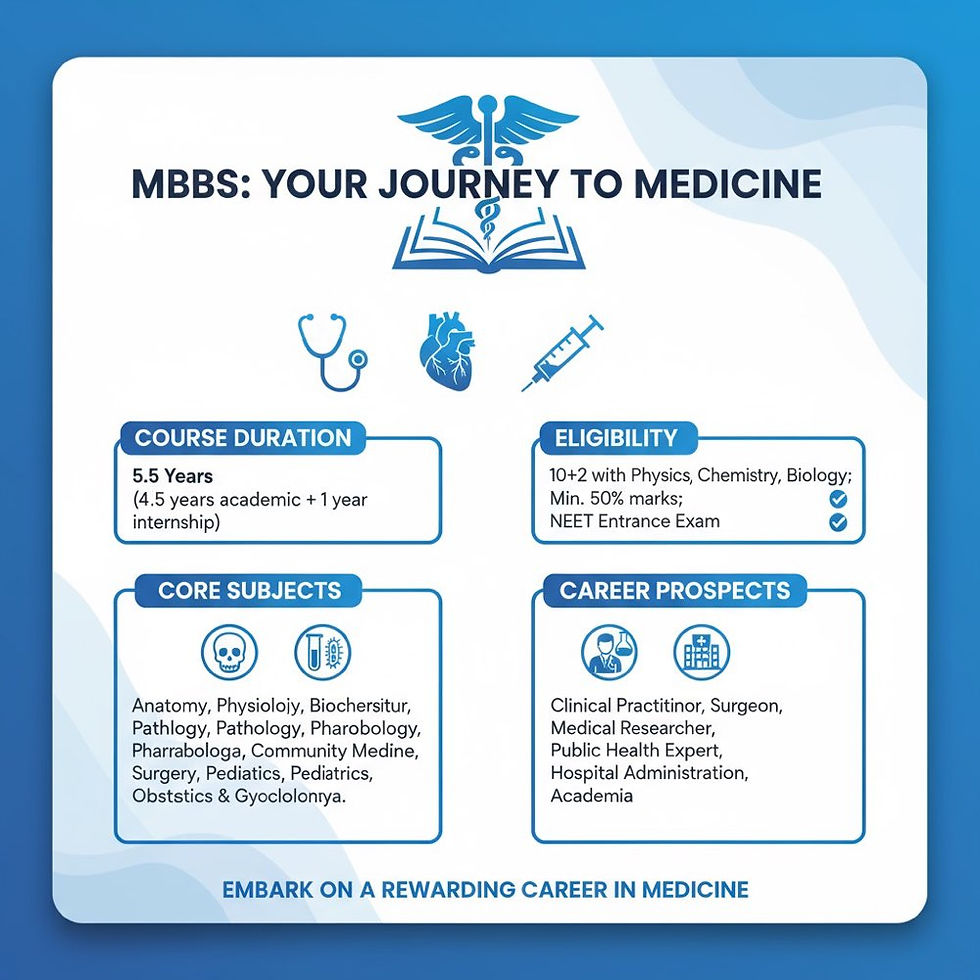
MBBS Course Details: A Complete Guide for Aspiring Doctors
If you dream of becoming a doctor, understanding the MBBS course details is your first step toward a rewarding career in medicine. MBBS, or Bachelor of Medicine and Bachelor of Surgery, is one of the most sought-after degrees among science students who aspire to work in healthcare. This comprehensive guide will walk you through everything you need to know about the MBBS course—its structure, duration, eligibility, subjects, admission process, and career opportunities.
What Is MBBS?
MBBS stands for Medicinae Baccalaureus, Baccalaureus Chirurgiae, meaning Bachelor of Medicine, Bachelor of Surgery. It is an undergraduate program that prepares students to diagnose, treat, and prevent diseases while promoting health and well-being. The MBBS degree integrates theoretical medical science with practical clinical training to build a strong foundation for future doctors.
MBBS Course Duration
The MBBS course usually spans 5.5 years, divided into two major parts:
Academic Study (4.5 years): This includes the pre-clinical, para-clinical, and clinical phases where students study subjects like anatomy, physiology, pathology, microbiology, and surgery.
Internship (1 year): After academic learning, students undergo a mandatory internship in recognized hospitals. This internship provides hands-on experience in different medical departments, such as general medicine, pediatrics, obstetrics, gynecology, and emergency care.
Some countries may slightly vary the structure or duration, but the general pattern remains similar worldwide.
Eligibility Criteria for MBBS
To pursue MBBS, students must meet specific eligibility requirements. The key criteria are:
Academic Qualification: Candidates should have completed 10+2 or equivalent with Physics, Chemistry, and Biology as core subjects.
Minimum Marks: Generally, a minimum of 50% aggregate marks in PCB (Physics, Chemistry, Biology) is required. For reserved categories, it may be 40%.
Age Limit: The minimum age is usually 17 years at the time of admission.
Entrance Exam: In India, candidates must qualify for NEET (National Eligibility cum Entrance Test) to secure admission in medical colleges. For abroad studies, NEET qualification is also required for eligibility as per the Medical Council of India (MCI/NMC).
MBBS Course Structure and Subjects
The MBBS course details consist of a combination of theoretical knowledge and practical exposure divided into three phases:
1. Pre-Clinical Phase
This phase introduces students to the basics of human anatomy, physiology, and biochemistry.
Anatomy
Physiology
Biochemistry
2. Para-Clinical Phase
In this stage, students move toward understanding diseases, microorganisms, and pharmacological treatments.
Pathology
Microbiology
Pharmacology
Forensic Medicine
3. Clinical Phase
The final phase focuses on the direct application of knowledge in clinical settings. Students interact with patients and learn diagnosis, treatment, and management skills.
General Medicine
Surgery
Pediatrics
Obstetrics & Gynecology
Ophthalmology
ENT (Ear, Nose & Throat)
Psychiatry
Community Medicine
During these phases, students also attend clinical postings and laboratory sessions to develop critical thinking, diagnostic skills, and empathy for patient care.
MBBS Admission Process
The admission process for MBBS can vary depending on whether you study in India or abroad. Here’s a general overview:
For MBBS in India:
Register and Apply for NEET: Appear for the NEET exam conducted by NTA (National Testing Agency).
Qualify NEET Cutoff: Achieve the minimum percentile required.
Counseling Process: Participate in centralized counseling for seats in government or private medical colleges.
Document Verification: Submit academic, identity, and medical eligibility documents.
Seat Allotment: Based on your NEET rank and preference, you’ll be allotted a college.
For MBBS Abroad:
Many students opt to study MBBS abroad due to affordable fees and high-quality education.
Choose a Recognized University: Select a medical university approved by NMC and WHO.
Submit Application and Documents: Provide academic records, passport, NEET scorecard, and other documents.
Receive Admission Letter: After university acceptance, complete visa formalities and travel arrangements.
Begin the Course: Start your MBBS journey in countries like Russia, Ukraine, the Philippines, or Kazakhstan.
Skills You Gain from MBBS
An MBBS degree not only imparts medical knowledge but also builds essential skills required for a successful medical career, such as:
Clinical reasoning and problem-solving
Communication and patient interaction
Research and analytical abilities
Leadership and teamwork
Ethical and professional decision-making
These skills ensure that future doctors can navigate both the scientific and emotional aspects of healthcare effectively.
Career Opportunities After MBBS
After completing an MBBS, graduates have numerous pathways to explore:
Postgraduate Studies (MD/MS): Specialize in fields such as cardiology, orthopedics, neurology, or radiology.
General Practice: Work as a medical officer, general physician, or family doctor.
Government and Defense Services: Serve in national health organizations, army hospitals, or public healthcare systems.
Research and Teaching: Contribute to medical research or teach in medical colleges.
Global Opportunities: MBBS graduates can take exams like USMLE (USA), PLAB (UK), or AMC (Australia) to pursue international medical practice.
The demand for qualified doctors continues to grow globally, ensuring strong job security and professional respect.
Why Study MBBS Abroad?
In recent years, studying MBBS abroad has become increasingly popular among Indian students. Here’s why:
Affordable Fees: Countries like Russia, Uzbekistan, Georgia, and Kazakhstan offer cost-effective MBBS programs.
Global Recognition: Degrees from WHO and NMC-approved universities are valued worldwide.
No Entrance Barrier: Many foreign universities do not require additional entrance tests beyond NEET.
Modern Infrastructure: International universities provide advanced labs, modern classrooms, and English-medium instructions.
Cultural Exposure: Studying abroad helps students develop a global perspective and adaptability.
Students who complete MBBS abroad can return to India, pass the NExT exam (National Exit Test), and start practicing as qualified doctors.
Conclusion
Understanding MBBS course details is essential for every aspiring doctor. It helps you make informed decisions about your medical education journey—whether in India or abroad. From eligibility and subjects to internships and career paths, every step you take in MBBS brings you closer to saving lives and serving humanity. Choosing the right university and preparing with dedication will make your dream of becoming a doctor a reality.